Complete guide · 4 min read
In-Depth Interviews in India: The Complete Guide
Everything you need to know about in-depth interviews in India: what it is, when to use it, methods, deliverables, timelines and how to choose a partner.
Quick answer
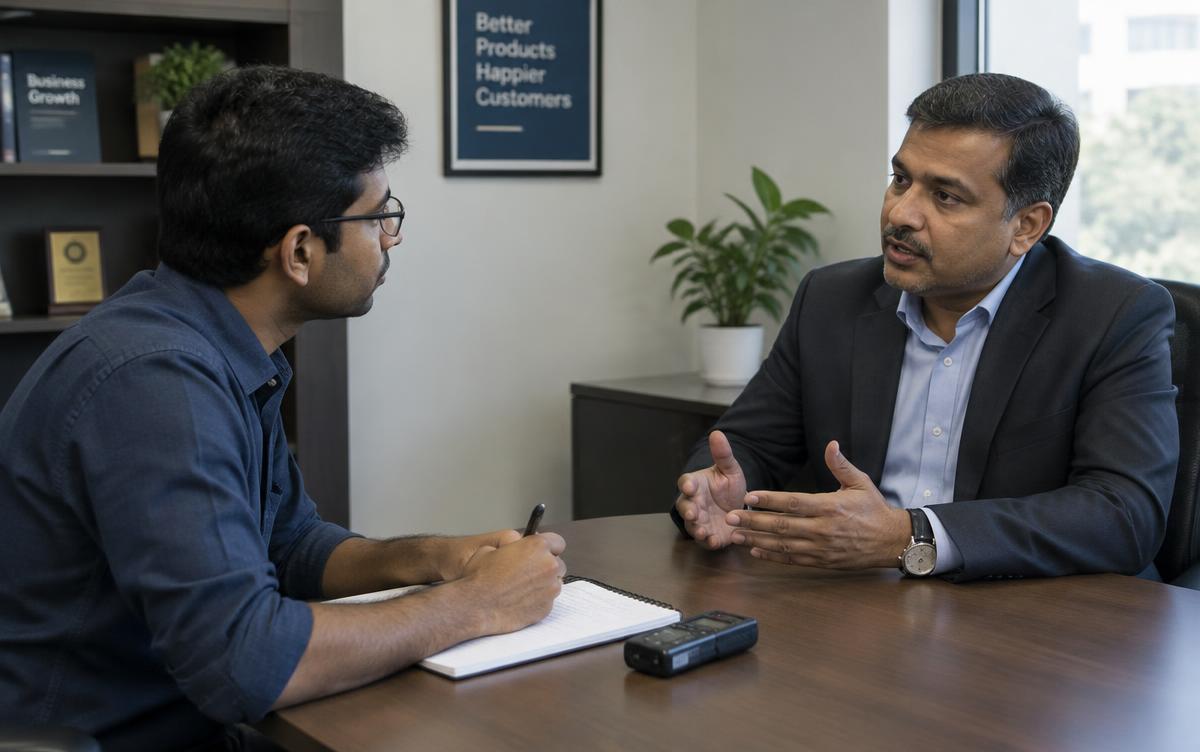
In-Depth Interviews is a qualitative research approach. One-to-one conversations that uncover the motivations behind decisions. In India it is typically delivered through face-to-face idis, telephonic idis, expert interviews, paired depths, and produces transcripts, thematic analysis, persona profiles.
At a glance
- Guide type
- Complete guide · 4 minute read
- Method covered
- In-Depth Interviews
- Research family
- Qualitative research
- Typical timeline
- 4–6 weeks from guide sign-off to the thematic report
- Typical sample
- 20–30 interviews per audience, stopping when new themes stop appearing
- Written for
- Teams new to the method · Brand and category managers · Consultants scoping a study
Key takeaways
- In-Depth Interviews is best used when you need to understand the 'why'
- India's diversity means city and language choices matter
- Quality control is the main difference between good and poor vendors
- Senior involvement drives the quality of insight
Reader intent
Who this guide is for
Three readers arrive here with different problems. Each should be able to act on this page without reading all of it.
Teams new to the method
Start here if you know the business question but are not yet sure that in-depth interviews is the right way to answer it.
Brand and category managers
Brief an agency in the method's own language, and judge what comes back on more than its price.
Consultants scoping a study
The methods, deliverables and timings here map straight onto a in-depth interviews scope of work.
01
What is in-depth interviews?
One-to-one conversations that uncover the motivations behind decisions.
It sits within the qualitative family of research methods. It is often combined with other approaches to give a fuller picture.
02
When should you use it?
Use it when a business decision is uncertain and the cost of being wrong is high.
- Launching a new product or entering a new city
- Explaining a drop in sales or share
- Choosing between strategic options
- Building a business case for investors or the board
03
Methods used in India
The right method depends on your audience, budget and timeline.
- Face-to-face IDIs
- Telephonic IDIs
- Expert interviews
- Paired depths
04
Typical deliverables
- Transcripts
- Thematic analysis
- Persona profiles
05
Making it work in India
India is many markets in one. Language, income, urbanisation and retail structure all vary by region, so a good study design reflects that diversity. This might mean regional quotas, local-language fieldwork, or separate readings for Tier 1 and Tier 2 cities.
06
How Market Research India can help
Market Research India designs and runs in-depth interviews projects across 50 Indian cities and 30 industries. A senior research director leads every study, and our own supervised teams handle the fieldwork. You get clear recommendations, not just data tables.
Share your objective and we will send a scoped, fixed-fee proposal within 24 hours, with a recommended method, sample and timeline.
What goes wrong
Common mistakes in in-depth interviews
Most disappointing in-depth interviews studies fail for reasons that were visible in the design, not in the fieldwork. These are the ones we see most often, and what to do instead.
- 01
Questions that carry their own answer
“What do you dislike about the service?” presumes dislike. Ask what happened last time, then follow the story rather than the hypothesis.
- 02
Accepting the first answer
The first response is a rationalisation. Laddering — asking why that matters, three or four times — is what separates a depth interview from a long survey.
- 03
Recruiting everyone from one source
Twenty-five interviews all sourced from a single customer list describe that list, not the market. Use at least two independent recruitment routes.
- 04
Counting mentions as if they were data
“14 of 25 said” lends a qualitative sample the authority of a survey it has not earned. Report themes and their reasoning, and quantify separately if you need numbers.
- 05
Moderator bias nobody checks
A moderator who already believes the answer nods at agreement and probes only dissent. Brief on the decision rather than the hypothesis, and review the first session before the rest go ahead.
- 06
Regional language nuance lost in translation
Category language in Hindi, Tamil or Marathi rarely survives live translation. Work in the respondent's language and translate the transcript, not the conversation.
Run through this before sign-off
Your checklist before you brief anyone
A working sequence for a in-depth interviews project. Most of it costs nothing, and it saves the two weeks a re-field would take.
- 1
Write the screener before the discussion guide; who you talk to decides more than what you ask.
- 2
Pilot two interviews and rewrite the guide before the rest are scheduled.
- 3
Record and transcribe with explicit consent, and keep the recording in the interview language.
- 4
Ladder every important answer with “and why does that matter to you?” at least twice.
- 5
Code to a shared framework, so two analysts reading one transcript reach the same themes.
- 6
Hold a same-day field debrief, before impressions harden into a story.
- 7
Agree in writing who acts on each finding, and by when, before the debrief ends.
Need in-depth interviews?
Get a scoped proposal within 24 hours.
Answers
Frequently asked questions
The questions buyers ask us most often before they commission in-depth interviews.
How long does in-depth interviews take?
Most projects take 3–6 weeks from sign-off to final report.
Can it be done online?
Many studies can be run fully or partly online. Some audiences still need face-to-face fieldwork.
From guide to project
Where in-depth interviews actually gets commissioned
If this guide has settled the method, these are the pages worth opening next: the service itself, and the markets where in-depth interviews is most often run for our clients.
The service
In-Depth Interviews in India
The commissioned version of this guide: face-to-face idis, telephonic idis, expert interviews, delivered as transcripts, thematic analysis, persona profiles.
ViewDelhi
In-Depth Interviews in Delhi NCR
Metro-scale in-depth interviews with supervised field teams, working in Hindi, Punjabi and English. Most often commissioned here by Government & Social Sector and Retail teams.
ViewKarnataka
In-Depth Interviews in Bangalore
Metro-scale in-depth interviews with supervised field teams, working in Tamil, Telugu, Kannada, Malayalam and English. Most often commissioned here by Information Technology & SaaS and E-commerce & Quick Commerce teams.
ViewTamil Nadu
In-Depth Interviews in Chennai
Metro-scale in-depth interviews with supervised field teams, working in Tamil, Telugu, Kannada, Malayalam and English. Most often commissioned here by Automotive and Manufacturing & Industrial teams.
ViewTelangana
In-Depth Interviews in Hyderabad
Metro-scale in-depth interviews with supervised field teams, working in Tamil, Telugu, Kannada, Malayalam and English. Most often commissioned here by Pharmaceuticals and Information Technology & SaaS teams.
ViewKarnataka
In-Depth Interviews in Hubli-Dharwad
Tier 2 in-depth interviews covering the city and its surrounding districts, working in Tamil, Telugu, Kannada, Malayalam and English. Most often commissioned here by Agriculture & Agritech and Education & EdTech teams.
View
Keep exploring
More reading on in-depth interviews
Grouped rather than listed, so you can find the one page you need instead of scanning a wall of links.
More on in-depth interviews
14Every angle we have published on this method: what it costs, how long it takes, how large the sample should be and how to choose a partner.
- How Much Does In-Depth Interviews Cost in India? A Pricing Guide
- How to Choose a In-Depth Interviews Agency in India
- In-Depth Interviews Checklist: 12 Steps Before You Commission a Study
- 7 Costly In-Depth Interviews Mistakes Brands Make in India
- In-Depth Interviews Sample Size and Sampling Guide for India
- How Long Does In-Depth Interviews Take? Project Timelines Explained
- In-Depth Interviews for Foreign Companies Entering India
- In-Depth Interviews in Tier 2 and Tier 3 India: How to Get It Right
Show 6 more
- In-Depth Interviews for Startups: Getting Evidence on a Budget
- How to Write a In-Depth Interviews Brief (Free Template)
- In-House vs Agency In-Depth Interviews: Which Is Right for You?
- Measuring the ROI of In-Depth Interviews
- In-Depth Interviews by Industry: Use Cases from FMCG to Healthcare
- In-Depth Interviews: 10 Questions to Ask Before You Hire a Research Firm
Other complete guide articles
19The same complete guide written for each of our other research methods, so you can compare like with like.
- Consumer Research in India: The Complete Guide
- B2B Market Research in India: The Complete Guide
- Focus Group Discussions in India: The Complete Guide
- Quantitative Surveys in India: The Complete Guide
- CATI Telephone Surveys in India: The Complete Guide
- Online Surveys in India: The Complete Guide
- Mystery Shopping in India: The Complete Guide
- Market Feasibility Studies in India: The Complete Guide
Show 11 more
- Competitor Analysis in India: The Complete Guide
- Brand Health Tracking in India: The Complete Guide
- Customer Satisfaction & NPS in India: The Complete Guide
- Product & Concept Testing in India: The Complete Guide
- Pricing Research in India: The Complete Guide
- Market Sizing & Forecasting in India: The Complete Guide
- Ethnographic Research in India: The Complete Guide
- Healthcare Market Research in India: The Complete Guide
- Retail Audit & Distribution in India: The Complete Guide
- Usage & Attitude Studies in India: The Complete Guide
- Advertising & Media Research in India: The Complete Guide
In-Depth Interviews city by city
50Local field teams, local languages and the sector mix each market is strongest in.
- In-Depth Interviews in MumbaiTier 1
- In-Depth Interviews in Delhi NCRTier 1
- In-Depth Interviews in BangaloreTier 1
- In-Depth Interviews in ChennaiTier 1
- In-Depth Interviews in HyderabadTier 1
- In-Depth Interviews in KolkataTier 1
- In-Depth Interviews in PuneTier 1
- In-Depth Interviews in AhmedabadTier 1
Show 42 more
- In-Depth Interviews in JaipurTier 2
- In-Depth Interviews in LucknowTier 2
- In-Depth Interviews in KanpurTier 2
- In-Depth Interviews in NagpurTier 2
- In-Depth Interviews in IndoreTier 2
- In-Depth Interviews in BhopalTier 2
- In-Depth Interviews in SuratTier 2
- In-Depth Interviews in VadodaraTier 2
- In-Depth Interviews in RajkotTier 2
- In-Depth Interviews in NashikTier 2
- In-Depth Interviews in AurangabadTier 2
- In-Depth Interviews in CoimbatoreTier 2
- In-Depth Interviews in MaduraiTier 2
- In-Depth Interviews in KochiTier 2
- In-Depth Interviews in ThiruvananthapuramTier 2
- In-Depth Interviews in VisakhapatnamTier 2
- In-Depth Interviews in VijayawadaTier 2
- In-Depth Interviews in MysoreTier 2
- In-Depth Interviews in MangaloreTier 2
- In-Depth Interviews in Hubli-DharwadTier 2
- In-Depth Interviews in ChandigarhTier 2
- In-Depth Interviews in LudhianaTier 2
- In-Depth Interviews in AmritsarTier 2
- In-Depth Interviews in JalandharTier 2
- In-Depth Interviews in DehradunTier 2
- In-Depth Interviews in AgraTier 2
- In-Depth Interviews in VaranasiTier 2
- In-Depth Interviews in PrayagrajTier 2
- In-Depth Interviews in MeerutTier 2
- In-Depth Interviews in NoidaTier 2
- In-Depth Interviews in GurugramTier 2
- In-Depth Interviews in FaridabadTier 2
- In-Depth Interviews in GhaziabadTier 2
- In-Depth Interviews in PatnaTier 2
- In-Depth Interviews in RanchiTier 2
- In-Depth Interviews in BhubaneswarTier 2
- In-Depth Interviews in RaipurTier 2
- In-Depth Interviews in GuwahatiTier 2
- In-Depth Interviews in JammuTier 2
- In-Depth Interviews in GoaTier 2
- In-Depth Interviews in JodhpurTier 2
- In-Depth Interviews in UdaipurTier 2
Related research services
19Qualitative methods first — these are the ones most often combined with in-depth interviews in a single study.
- Focus Group DiscussionsQualitative
- Ethnographic ResearchQualitative
- Consumer ResearchQuantitative
- B2B Market ResearchStrategy
- Quantitative SurveysQuantitative
- CATI Telephone SurveysQuantitative
- Online SurveysQuantitative
- Mystery ShoppingSpecialist
Show 11 more
- Market Feasibility StudiesStrategy
- Competitor AnalysisStrategy
- Brand Health TrackingQuantitative
- Customer Satisfaction & NPSQuantitative
- Product & Concept TestingQuantitative
- Pricing ResearchStrategy
- Market Sizing & ForecastingStrategy
- Healthcare Market ResearchSpecialist
- Retail Audit & DistributionSpecialist
- Usage & Attitude StudiesQuantitative
- Advertising & Media ResearchQuantitative