Quantitative research
CATI Telephone Surveys in India
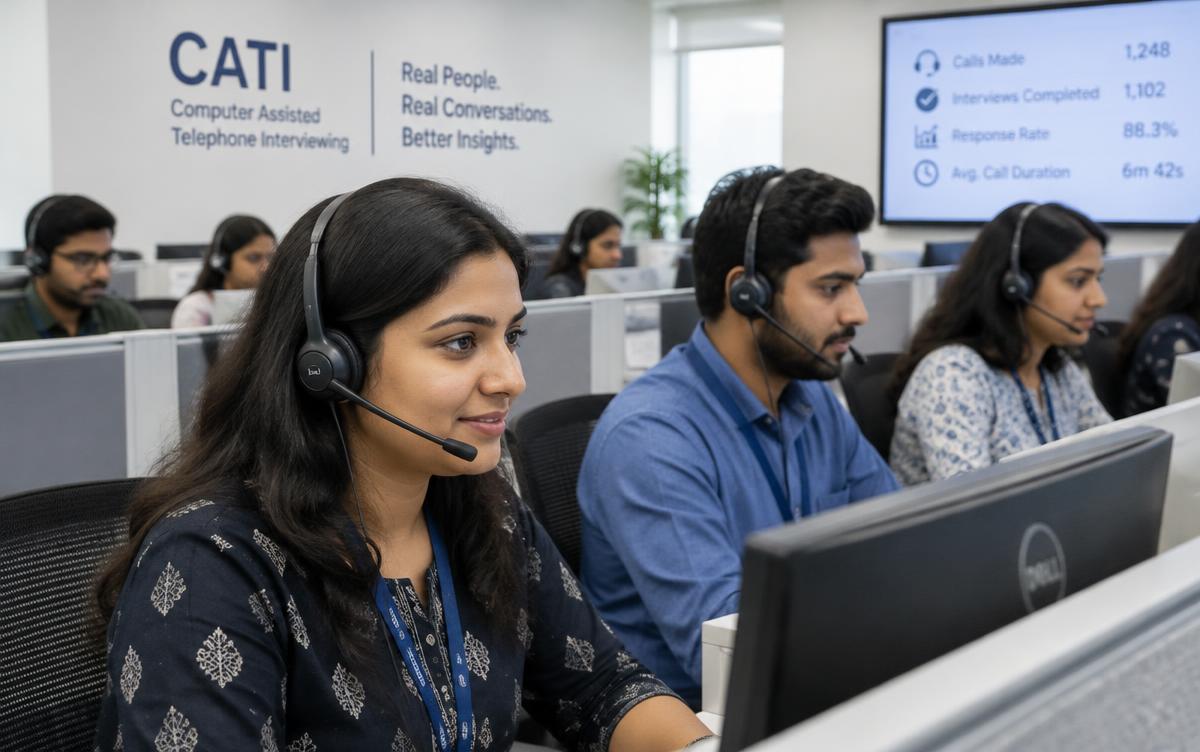
Computer-assisted telephone interviewing from our multilingual call centre.
Quick answer
Use this method when the question calls for fast, monitored, national numbers. Market Research India runs 300–3,000 completes over 1–3 weeks, in 50 Indian cities and fourteen languages.
Proposal in 24 hours
Scoped, itemised and fixed-fee.
50 cities, 14 languages
Our own supervised field teams.
Senior-led, NDA-first
A research director on every project.
2,400+
Projects delivered
50
Cities with field teams
30
Industries covered
14
Indian languages
01
Questions this method is built to answer
Commission this when one of the questions below is holding up a decision. If your question is not on the list, say so in the brief — we would rather recommend a different method than sell you this one.
How quickly can we read a national sample before a decision deadline?
What do customers say when asked by a neutral third party rather than by us?
Can we reach this audience at all without travelling to them?
How are the numbers moving week by week while the campaign runs?
Which markets need a follow-up in person once the phone read is in?
02
How we run it
5 stages, with one research director accountable across all of them. The person who scopes the study is the person who presents the findings.
- 1
Build the sample frame
Numbers are drawn from your own database or a licensed frame, de-duplicated and stratified by state and circle before any dialling.
- 2
Script with the logic locked
Quotas, routing and range checks live in the script. Questions are rewritten for the ear, because a phone respondent cannot re-read a grid.
- 3
Pilot fifty calls
A pilot batch tests length, drop-off points and language comprehension, and the script is adjusted before the main launch.
- 4
Dial across day-parts
Calls are spread across mornings, evenings and weekends with up to five attempts per number, which protects the sample from a daytime bias.
- 5
Monitor live and report daily
Supervisors listen in while interviews run, and you see completes, quotas and refusal rates every morning rather than at the end.
03
At a glance
CATI Telephone Surveys — typical study parameters
- Typical scale
- 300 to 3,000 completes from a multilingual call centre, with 12 to 20 minute interviews
- Fieldwork window
- One to three weeks, with daily completes from day one
- Lead time
- Scripting and pilot in three days; dialling starts in the first week
- Coverage
- National reach from one centre, including markets where in-person fieldwork is slow or costly
- Languages
- Interviewers working in fourteen languages, matched to the respondent's number and state
- Core methods
- CATI scripting · Quota control · Call monitoring · Multilingual teams
- Reporting
- Daily progress reports, clean datasets and a topline within 48 hours of the last call
- Best suited to
- Reaching a dispersed sample quickly
04
What you receive
3 named deliverables, each written to be used rather than filed. Everything ships with the underlying data, so your team can keep working after the debrief.
Daily progress
A daily dashboard of completes against quota, call outcomes and refusal reasons while fieldwork is still open.
Clean datasets
Datasets delivered cleaned, labelled and de-duplicated, with the full call-outcome history attached.
Topline reports
A topline with the headline numbers inside two days of the last completed interview.
05
Quality control in the field
Fieldwork in India fails quietly when nobody checks it. These controls are run on every cati telephone surveys study, by a quality team that reports separately from the field team.
Silent live monitoring
Supervisors listen in on at least ten per cent of live calls, and on the full recording of any interview the system flags for pace or routing.
Logic locked into the script
Routing, quotas and range checks sit in the CATI script, so an interviewer cannot skip a filter or force a response to close a quota.
Call-back discipline
Up to five attempts across different days and day-parts before a number is retired. This is what keeps a telephone sample from becoming a daytime sample.
A number-level audit trail
Every dial, outcome and duration is logged, so contact, response and refusal rates are reported from the record rather than estimated.
Interviewer-level performance review
Completion, refusal and average-duration rates are tracked per interviewer, and anyone outside the band is re-briefed or removed from the study.
Method choice
CATI Telephone Surveys, or one of these instead?
Most briefs can be answered more than one way, and the wrong instrument is the most expensive mistake in research. Here is how cati telephone surveys compares with the two methods buyers most often weigh against it.
| CATI Telephone Surveys | Online Surveys | Quantitative Surveys | |
|---|---|---|---|
| Best used for | Reaching a dispersed sample quickly | Speed, volume and anything needing visual stimulus | Producing numbers that survive scrutiny |
| Typical scale | 300–3,000 completes | 300–10,000 completes | 400–5,000 completes |
| Fieldwork window | 1–3 weeks | 3 days–2 weeks | 3–6 weeks |
| Evidence produced | Fast, monitored, national numbers | Large samples with advanced designs built in | Measured incidence with a stated margin of error |
| Projects to a population | |||
| Relative cost | Lower than face to face | Lowest per complete | Scales with sample and incidence |
Where this method stops
City coverage
Where this work is strongest
We field in all 50 cities, but these are the markets where this method has the most to offer — because of the infrastructure, the respondent base or the sectors concentrated there.
Tier 1 · Maharashtra
Mumbai
Ward-level sampling frames covering every zone of the city. Depth in Banking & Financial Services and Media & Entertainment, with work running in Marathi, Gujarati, Hindi and English.
ViewTier 1 · Delhi
Delhi NCR
Ward-level sampling frames covering every zone of the city. Depth in Government & Social Sector and Retail, with work running in Hindi, Punjabi and English.
ViewTier 1 · Karnataka
Bangalore
Ward-level sampling frames covering every zone of the city. Depth in Information Technology & SaaS and E-commerce & Quick Commerce, with work running in Tamil, Telugu, Kannada, Malayalam and English.
ViewTier 1 · Tamil Nadu
Chennai
Ward-level sampling frames covering every zone of the city. Depth in Automotive and Manufacturing & Industrial, with work running in Tamil, Telugu, Kannada, Malayalam and English.
ViewTier 1 · Telangana
Hyderabad
Ward-level sampling frames covering every zone of the city. Depth in Pharmaceuticals and Information Technology & SaaS, with work running in Tamil, Telugu, Kannada, Malayalam and English.
ViewTier 1 · West Bengal
Kolkata
Ward-level sampling frames covering every zone of the city. Depth in FMCG and Logistics & Supply Chain, with work running in Bengali, Odia, Hindi and English.
ViewTier 1 · Maharashtra
Pune
Ward-level sampling frames covering every zone of the city. Depth in Automotive and Information Technology & SaaS, with work running in Marathi, Gujarati, Hindi and English.
ViewTier 1 · Gujarat
Ahmedabad
Ward-level sampling frames covering every zone of the city. Depth in Chemicals & Specialty Materials and Pharmaceuticals, with work running in Marathi, Gujarati, Hindi and English.
View
Before you brief us
Frequently asked questions
How long does a cati telephone surveys project take?
One to three weeks, with daily completes from day one. Scripting and pilot in three days; dialling starts in the first week. Analysis and reporting add a further one to two weeks, so most studies close inside six to ten weeks from brief to debrief.
What sample size do you recommend?
300 to 3,000 completes from a multilingual call centre, with 12 to 20 minute interviews. The right number is set by the smallest subgroup you need to report separately, not by a round figure, and we will say when a smaller sample would answer the question just as well.
What drives the cost of cati telephone surveys in India?
Incidence and audience difficulty first, then scale, the number of cities and languages, and the depth of reporting. Relative to other methods on this site, the cost profile is: lower than face to face. Send a brief and you get a fixed-fee proposal within 24 hours.
When is cati telephone surveys the wrong choice?
Anything needing stimulus, long grids or more than twenty minutes of attention belongs in person or online.
How do you control quality in the field?
Supervisors listen in on at least ten per cent of live calls, and on the full recording of any interview the system flags for pace or routing. Beyond that, interviewer-level performance review: completion, refusal and average-duration rates are tracked per interviewer, and anyone outside the band is re-briefed or removed from the study.
Can international teams commission this from outside India?
Yes. We report in English, run calls across US, European and Asian time zones, and handle local-language fieldwork and translation end to end.
Study at a glance
- Discipline
- Quantitative
- Typical scale
- 300–3,000 completes
- Field window
- 1–3 weeks
- Projectable
- Yes
- Relative cost
- Lower than face to face
- Cities covered
- 50
Keep exploring
Everything built on this method
8 metros, 42 Tier 2 markets, 30 sectors and 15 guides, each applying cati telephone surveys to one specific context.
Tier 1 metros
8Full-scale fieldwork, viewing facilities and senior decision-maker access.
- CATI Telephone Surveys in MumbaiMaharashtra
- CATI Telephone Surveys in Delhi NCRDelhi
- CATI Telephone Surveys in BangaloreKarnataka
- CATI Telephone Surveys in ChennaiTamil Nadu
- CATI Telephone Surveys in HyderabadTelangana
- CATI Telephone Surveys in KolkataWest Bengal
- CATI Telephone Surveys in PuneMaharashtra
- CATI Telephone Surveys in AhmedabadGujarat
Tier 2 markets
42Each city covered from a local field base that also reaches the surrounding districts.
- CATI Telephone Surveys in JaipurRajasthan
- CATI Telephone Surveys in LucknowUttar Pradesh
- CATI Telephone Surveys in KanpurUttar Pradesh
- CATI Telephone Surveys in NagpurMaharashtra
- CATI Telephone Surveys in IndoreMadhya Pradesh
- CATI Telephone Surveys in BhopalMadhya Pradesh
- CATI Telephone Surveys in SuratGujarat
- CATI Telephone Surveys in VadodaraGujarat
Show 34 more
- CATI Telephone Surveys in RajkotGujarat
- CATI Telephone Surveys in NashikMaharashtra
- CATI Telephone Surveys in AurangabadMaharashtra
- CATI Telephone Surveys in CoimbatoreTamil Nadu
- CATI Telephone Surveys in MaduraiTamil Nadu
- CATI Telephone Surveys in KochiKerala
- CATI Telephone Surveys in ThiruvananthapuramKerala
- CATI Telephone Surveys in VisakhapatnamAndhra Pradesh
- CATI Telephone Surveys in VijayawadaAndhra Pradesh
- CATI Telephone Surveys in MysoreKarnataka
- CATI Telephone Surveys in MangaloreKarnataka
- CATI Telephone Surveys in Hubli-DharwadKarnataka
- CATI Telephone Surveys in ChandigarhChandigarh
- CATI Telephone Surveys in LudhianaPunjab
- CATI Telephone Surveys in AmritsarPunjab
- CATI Telephone Surveys in JalandharPunjab
- CATI Telephone Surveys in DehradunUttarakhand
- CATI Telephone Surveys in AgraUttar Pradesh
- CATI Telephone Surveys in VaranasiUttar Pradesh
- CATI Telephone Surveys in PrayagrajUttar Pradesh
- CATI Telephone Surveys in MeerutUttar Pradesh
- CATI Telephone Surveys in NoidaUttar Pradesh
- CATI Telephone Surveys in GurugramHaryana
- CATI Telephone Surveys in FaridabadHaryana
- CATI Telephone Surveys in GhaziabadUttar Pradesh
- CATI Telephone Surveys in PatnaBihar
- CATI Telephone Surveys in RanchiJharkhand
- CATI Telephone Surveys in BhubaneswarOdisha
- CATI Telephone Surveys in RaipurChhattisgarh
- CATI Telephone Surveys in GuwahatiAssam
- CATI Telephone Surveys in JammuJammu & Kashmir
- CATI Telephone Surveys in GoaGoa
- CATI Telephone Surveys in JodhpurRajasthan
- CATI Telephone Surveys in UdaipurRajasthan
By industry
30The same method applied to one sector’s audiences, vocabulary and buying process.
- FMCG cati telephone surveys
- Healthcare cati telephone surveys
- Pharmaceuticals cati telephone surveys
- Banking & Financial Services cati telephone surveys
- Insurance cati telephone surveys
- Automotive cati telephone surveys
- Electric Vehicles cati telephone surveys
- Real Estate cati telephone surveys
Show 22 more
- Education & EdTech cati telephone surveys
- Retail cati telephone surveys
- E-commerce & Quick Commerce cati telephone surveys
- Telecom cati telephone surveys
- Information Technology & SaaS cati telephone surveys
- Energy & Renewables cati telephone surveys
- Agriculture & Agritech cati telephone surveys
- Manufacturing & Industrial cati telephone surveys
- Hospitality & Tourism cati telephone surveys
- Food & Beverage cati telephone surveys
- Consumer Durables & Electronics cati telephone surveys
- Fashion & Apparel cati telephone surveys
- Media & Entertainment cati telephone surveys
- Logistics & Supply Chain cati telephone surveys
- Chemicals & Specialty Materials cati telephone surveys
- Construction & Infrastructure cati telephone surveys
- Beauty & Personal Care cati telephone surveys
- Fintech cati telephone surveys
- Gaming & Esports cati telephone surveys
- Aviation & Airports cati telephone surveys
- Medical Devices cati telephone surveys
- Government & Social Sector cati telephone surveys
Guides and pricing
15Cost drivers, briefing checklists and buyer guides written for this method.
- How Much Does CATI Telephone Surveys Cost in India? A Pricing Guide4 min
- CATI Telephone Surveys in India: The Complete Guide4 min
- How to Choose a CATI Telephone Surveys Agency in India4 min
- CATI Telephone Surveys Checklist: 12 Steps Before You Commission a Study4 min
- 7 Costly CATI Telephone Surveys Mistakes Brands Make in India4 min
- CATI Telephone Surveys Sample Size and Sampling Guide for India4 min
- How Long Does CATI Telephone Surveys Take? Project Timelines Explained4 min
- CATI Telephone Surveys for Foreign Companies Entering India4 min
Show 7 more
- CATI Telephone Surveys in Tier 2 and Tier 3 India: How to Get It Right4 min
- CATI Telephone Surveys for Startups: Getting Evidence on a Budget4 min
- How to Write a CATI Telephone Surveys Brief (Free Template)4 min
- In-House vs Agency CATI Telephone Surveys: Which Is Right for You?4 min
- Measuring the ROI of CATI Telephone Surveys4 min
- CATI Telephone Surveys by Industry: Use Cases from FMCG to Healthcare4 min
- CATI Telephone Surveys: 10 Questions to Ask Before You Hire a Research Firm4 min
Other quantitative methods
8Closest alternatives, where a different instrument may answer the question better.
Every other service
11The full method set, from qualitative immersion to strategic modelling.
Next step
Ready to scope a cati telephone surveys study?