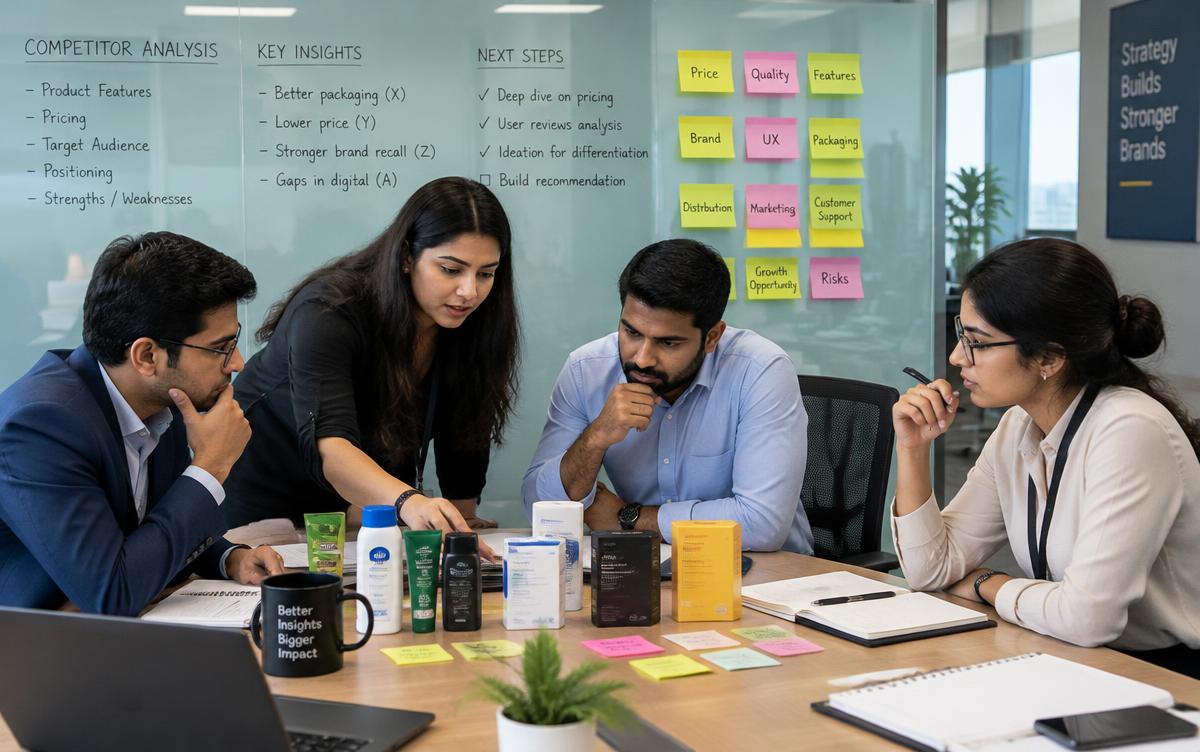
Strategy research
Competitor Analysis in India
A clear view of competitor positioning, pricing, distribution and strategy.
Quick answer
Market Research India runs competitor analysis across India: 5–15 competitors, 3–6 weeks in field, and competitor profiles, a swot per player and a positioning map, refreshed on an agreed cycle.
Proposal in 24 hours
Scoped, itemised and fixed-fee.
50 cities, 14 languages
Our own supervised field teams.
Senior-led, NDA-first
A research director on every project.
2,400+
Projects delivered
50
Cities with field teams
30
Industries covered
14
Indian languages
01
What this method settles
Commission this when one of the questions below is holding up a decision. If your question is not on the list, say so in the brief — we would rather recommend a different method than sell you this one.
What is the real street price of each competitor, after trade schemes?
Where are they distributed that we are not?
Why are we losing the deals we lose, in the buyer's own words?
Which claims and positions are already occupied in this category?
What is their next move likely to be, and what would signal it early?
02
How we run it
5 stages, with one research director accountable across all of them. The person who scopes the study is the person who presents the findings.
- 1
Define the competitive set honestly
We include the substitutes customers actually consider, which is often wider than the set your category reviews assume.
- 2
Profile from the public record
Filings, listings, job posts, patents and campaign history are assembled into a profile with each claim dated and sourced.
- 3
Check the shelf and the street
Field auditors record actual selling price, scheme, facings and availability, because list price and street price rarely match in India.
- 4
Run win-loss interviews
Buyers who chose a competitor are interviewed by a neutral third party, which produces answers your sales team will never be given.
- 5
Map and brief
Positions are plotted on the dimensions buyers use, and the team is briefed on where the open ground actually is.
03
At a glance
Competitor Analysis — typical study parameters
- Typical scale
- Five to fifteen competitors profiled, with price tracking across 20 to 200 outlets or listings
- Fieldwork window
- Three to six weeks, or continuous for price tracking
- Lead time
- Desk profiling starts at once; trade checks begin in the second week
- Coverage
- National with regional price cuts, covering general trade, modern trade and online listings
- Languages
- Trade and dealer conversations in the local language
- Core methods
- Competitive benchmarking · Price tracking · Channel mapping · Win-loss interviews
- Reporting
- Competitor profiles, a SWOT per player and a positioning map, refreshed on an agreed cycle
- Best suited to
- Knowing what rivals are actually doing, not what they announce
04
What you receive
3 named deliverables, each written to be used rather than filed. Everything ships with the underlying data, so your team can keep working after the debrief.
Competitor profiles
A profile per competitor covering portfolio, pricing, distribution, go-to-market and recent strategic moves, each claim dated.
SWOT
A SWOT per player written to be usable, with the implication for your plan rather than a four-box summary.
Positioning map
A positioning map on the axes buyers actually use, showing crowded ground and the space nobody currently holds.
05
How the fieldwork is validated
Fieldwork in India fails quietly when nobody checks it. These controls are run on every competitor analysis study, by a quality team that reports separately from the field team.
Every number carries its source
Each input in the model names its source, its date and any adjustment we applied, so your team can argue with the assumption rather than the answer.
Built twice, from both directions
Demand is estimated top-down and bottom-up independently. Where the two disagree by more than fifteen per cent, we go back to primary checks before reconciling.
Validated with people in the trade
Assumptions are tested with eight to fifteen operators, distributors or specialists before they harden into a forecast.
An assumption register you can edit
The model is handed over as a live workbook. Change an input and the forecast moves, which is what makes it useful after we leave.
Lawful collection only
Work uses public records, trade observation and consenting interviews. We do not misrepresent identity to obtain confidential competitor information.
Method choice
Competitor Analysis, or one of these instead?
Most briefs can be answered more than one way, and the wrong instrument is the most expensive mistake in research. Here is how competitor analysis compares with the two methods buyers most often weigh against it.
| Competitor Analysis | Market Sizing & Forecasting | B2B Market Research | |
|---|---|---|---|
| Best used for | Knowing what rivals are actually doing, not what they announce | Putting a defensible number on an opportunity | Understanding how an organisation actually decides to buy |
| Typical scale | 5–15 competitors | 10–25 validation interviews | 25–60 interviews |
| Fieldwork window | 3–6 weeks | 4–8 weeks | 4–7 weeks |
| Evidence produced | Observed pricing, placement and win-loss reasons | A reconciled estimate with a visible method | Named, verified decision makers on the record |
| Projects to a population | |||
| Relative cost | Moderate, lower when continuous | Fixed fee by scope | High per interview, moderate overall |
Where this method stops
City coverage
Where this work is strongest
We field in all 50 cities, but these are the markets where this method has the most to offer — because of the infrastructure, the respondent base or the sectors concentrated there.
Tier 1 · Maharashtra
Mumbai
Head offices and senior decision makers inside one travel radius. Depth in Banking & Financial Services and Media & Entertainment, with work running in Marathi, Gujarati, Hindi and English.
ViewTier 1 · Delhi
Delhi NCR
Head offices and senior decision makers inside one travel radius. Depth in Government & Social Sector and Retail, with work running in Hindi, Punjabi and English.
ViewTier 1 · Karnataka
Bangalore
Head offices and senior decision makers inside one travel radius. Depth in Information Technology & SaaS and E-commerce & Quick Commerce, with work running in Tamil, Telugu, Kannada, Malayalam and English.
ViewTier 1 · Tamil Nadu
Chennai
Head offices and senior decision makers inside one travel radius. Depth in Automotive and Manufacturing & Industrial, with work running in Tamil, Telugu, Kannada, Malayalam and English.
ViewTier 1 · Telangana
Hyderabad
Head offices and senior decision makers inside one travel radius. Depth in Pharmaceuticals and Information Technology & SaaS, with work running in Tamil, Telugu, Kannada, Malayalam and English.
ViewTier 1 · West Bengal
Kolkata
Head offices and senior decision makers inside one travel radius. Depth in FMCG and Logistics & Supply Chain, with work running in Bengali, Odia, Hindi and English.
ViewTier 1 · Maharashtra
Pune
Head offices and senior decision makers inside one travel radius. Depth in Automotive and Information Technology & SaaS, with work running in Marathi, Gujarati, Hindi and English.
ViewTier 1 · Gujarat
Ahmedabad
Head offices and senior decision makers inside one travel radius. Depth in Chemicals & Specialty Materials and Pharmaceuticals, with work running in Marathi, Gujarati, Hindi and English.
View
Before you brief us
Frequently asked questions
How long does a competitor analysis project take?
Three to six weeks, or continuous for price tracking. Desk profiling starts at once; trade checks begin in the second week. Analysis and reporting add a further one to two weeks, so most studies close inside six to ten weeks from brief to debrief.
What sample size do you recommend?
Five to fifteen competitors profiled, with price tracking across 20 to 200 outlets or listings. The right number is set by the smallest subgroup you need to report separately, not by a round figure, and we will say when a smaller sample would answer the question just as well.
What drives the cost of competitor analysis in India?
Incidence and audience difficulty first, then scale, the number of cities and languages, and the depth of reporting. Relative to other methods on this site, the cost profile is: moderate, lower when continuous. Send a brief and you get a fixed-fee proposal within 24 hours.
When is competitor analysis the wrong choice?
Competitor work explains the field you are playing on. It will not tell you what customers want that nobody yet offers.
How do you control quality in the field?
Each input in the model names its source, its date and any adjustment we applied, so your team can argue with the assumption rather than the answer. Beyond that, lawful collection only: work uses public records, trade observation and consenting interviews. We do not misrepresent identity to obtain confidential competitor information.
Can international teams commission this from outside India?
Yes. We report in English, run calls across US, European and Asian time zones, and handle local-language fieldwork and translation end to end.
Study at a glance
- Discipline
- Strategy
- Typical scale
- 5–15 competitors
- Field window
- 3–6 weeks
- Projectable
- Directional
- Relative cost
- Moderate, lower when continuous
- Cities covered
- 50
Keep exploring
Everything built on this method
8 metros, 42 Tier 2 markets, 30 sectors and 15 guides, each applying competitor analysis to one specific context.
Tier 1 metros
8Full-scale fieldwork, viewing facilities and senior decision-maker access.
- Competitor Analysis in MumbaiMaharashtra
- Competitor Analysis in Delhi NCRDelhi
- Competitor Analysis in BangaloreKarnataka
- Competitor Analysis in ChennaiTamil Nadu
- Competitor Analysis in HyderabadTelangana
- Competitor Analysis in KolkataWest Bengal
- Competitor Analysis in PuneMaharashtra
- Competitor Analysis in AhmedabadGujarat
Tier 2 markets
42Each city covered from a local field base that also reaches the surrounding districts.
- Competitor Analysis in JaipurRajasthan
- Competitor Analysis in LucknowUttar Pradesh
- Competitor Analysis in KanpurUttar Pradesh
- Competitor Analysis in NagpurMaharashtra
- Competitor Analysis in IndoreMadhya Pradesh
- Competitor Analysis in BhopalMadhya Pradesh
- Competitor Analysis in SuratGujarat
- Competitor Analysis in VadodaraGujarat
Show 34 more
- Competitor Analysis in RajkotGujarat
- Competitor Analysis in NashikMaharashtra
- Competitor Analysis in AurangabadMaharashtra
- Competitor Analysis in CoimbatoreTamil Nadu
- Competitor Analysis in MaduraiTamil Nadu
- Competitor Analysis in KochiKerala
- Competitor Analysis in ThiruvananthapuramKerala
- Competitor Analysis in VisakhapatnamAndhra Pradesh
- Competitor Analysis in VijayawadaAndhra Pradesh
- Competitor Analysis in MysoreKarnataka
- Competitor Analysis in MangaloreKarnataka
- Competitor Analysis in Hubli-DharwadKarnataka
- Competitor Analysis in ChandigarhChandigarh
- Competitor Analysis in LudhianaPunjab
- Competitor Analysis in AmritsarPunjab
- Competitor Analysis in JalandharPunjab
- Competitor Analysis in DehradunUttarakhand
- Competitor Analysis in AgraUttar Pradesh
- Competitor Analysis in VaranasiUttar Pradesh
- Competitor Analysis in PrayagrajUttar Pradesh
- Competitor Analysis in MeerutUttar Pradesh
- Competitor Analysis in NoidaUttar Pradesh
- Competitor Analysis in GurugramHaryana
- Competitor Analysis in FaridabadHaryana
- Competitor Analysis in GhaziabadUttar Pradesh
- Competitor Analysis in PatnaBihar
- Competitor Analysis in RanchiJharkhand
- Competitor Analysis in BhubaneswarOdisha
- Competitor Analysis in RaipurChhattisgarh
- Competitor Analysis in GuwahatiAssam
- Competitor Analysis in JammuJammu & Kashmir
- Competitor Analysis in GoaGoa
- Competitor Analysis in JodhpurRajasthan
- Competitor Analysis in UdaipurRajasthan
By industry
30The same method applied to one sector’s audiences, vocabulary and buying process.
- FMCG competitor analysis
- Healthcare competitor analysis
- Pharmaceuticals competitor analysis
- Banking & Financial Services competitor analysis
- Insurance competitor analysis
- Automotive competitor analysis
- Electric Vehicles competitor analysis
- Real Estate competitor analysis
Show 22 more
- Education & EdTech competitor analysis
- Retail competitor analysis
- E-commerce & Quick Commerce competitor analysis
- Telecom competitor analysis
- Information Technology & SaaS competitor analysis
- Energy & Renewables competitor analysis
- Agriculture & Agritech competitor analysis
- Manufacturing & Industrial competitor analysis
- Hospitality & Tourism competitor analysis
- Food & Beverage competitor analysis
- Consumer Durables & Electronics competitor analysis
- Fashion & Apparel competitor analysis
- Media & Entertainment competitor analysis
- Logistics & Supply Chain competitor analysis
- Chemicals & Specialty Materials competitor analysis
- Construction & Infrastructure competitor analysis
- Beauty & Personal Care competitor analysis
- Fintech competitor analysis
- Gaming & Esports competitor analysis
- Aviation & Airports competitor analysis
- Medical Devices competitor analysis
- Government & Social Sector competitor analysis
Guides and pricing
15Cost drivers, briefing checklists and buyer guides written for this method.
- How Much Does Competitor Analysis Cost in India? A Pricing Guide4 min
- Competitor Analysis in India: The Complete Guide4 min
- How to Choose a Competitor Analysis Agency in India4 min
- Competitor Analysis Checklist: 12 Steps Before You Commission a Study4 min
- 7 Costly Competitor Analysis Mistakes Brands Make in India4 min
- Competitor Analysis Sample Size and Sampling Guide for India4 min
- How Long Does Competitor Analysis Take? Project Timelines Explained4 min
- Competitor Analysis for Foreign Companies Entering India4 min
Show 7 more
- Competitor Analysis in Tier 2 and Tier 3 India: How to Get It Right4 min
- Competitor Analysis for Startups: Getting Evidence on a Budget4 min
- How to Write a Competitor Analysis Brief (Free Template)4 min
- In-House vs Agency Competitor Analysis: Which Is Right for You?4 min
- Measuring the ROI of Competitor Analysis4 min
- Competitor Analysis by Industry: Use Cases from FMCG to Healthcare4 min
- Competitor Analysis: 10 Questions to Ask Before You Hire a Research Firm4 min
Other strategy methods
4Closest alternatives, where a different instrument may answer the question better.
Every other service
15The full method set, from qualitative immersion to strategic modelling.
Next step
Ready to scope a competitor analysis study?