Qualitative research
Focus Group Discussions in India
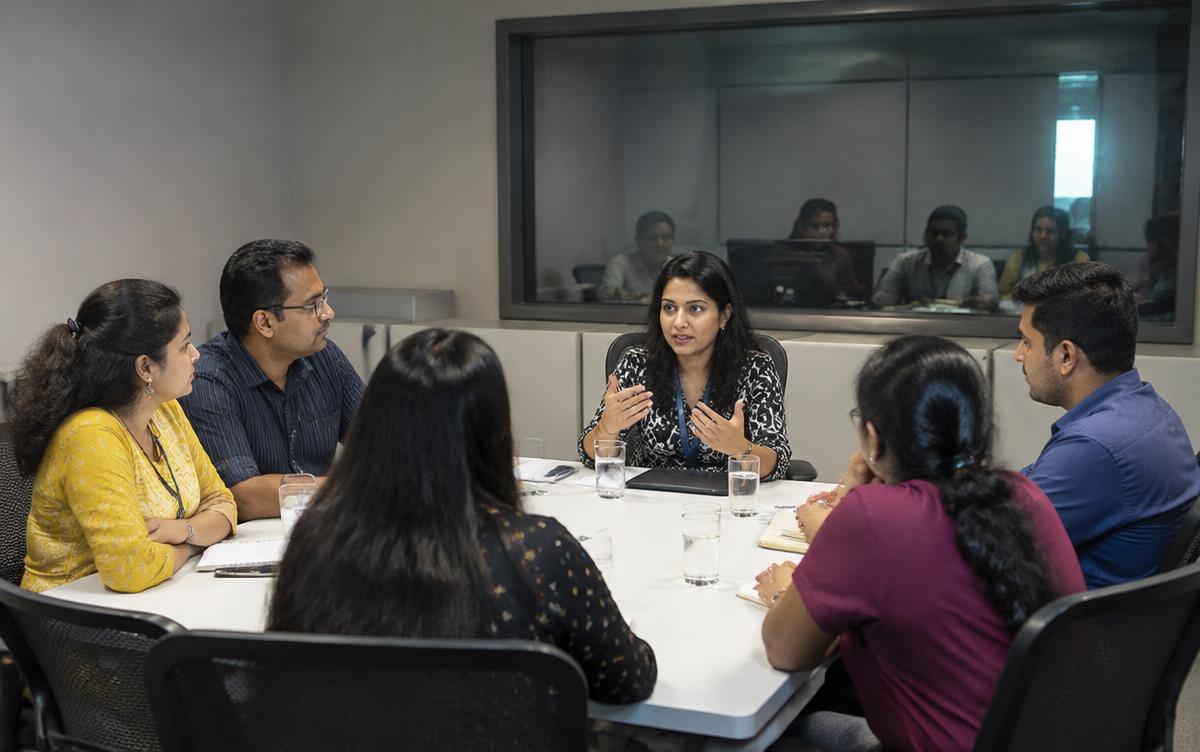
Moderated group discussions in viewing facilities and online, in English and 12+ Indian languages.
Quick answer
Market Research India runs focus group discussions across India: 6–12 groups, 2–3 weeks in field, and edited video highlights, verbatim themes and an insight report debriefed within a week of the last group.
Proposal in 24 hours
Scoped, itemised and fixed-fee.
50 cities, 14 languages
Our own supervised field teams.
Senior-led, NDA-first
A research director on every project.
2,400+
Projects delivered
50
Cities with field teams
30
Industries covered
14
Indian languages
01
What this method settles
Commission this when one of the questions below is holding up a decision. If your question is not on the list, say so in the brief — we would rather recommend a different method than sell you this one.
What language do buyers use for this category when we are not in the room?
Which of three positionings survives being challenged by other users?
What do people say when the pack, the ad or the price is put in front of them?
Where does our communication lose people in the first five seconds?
What social permission or embarrassment sits around this purchase?
02
How we run it
5 stages, with one research director accountable across all of them. The person who scopes the study is the person who presents the findings.
- 1
Write the screener against the decision
We screen for the behaviour that matters to your question, not just demographics, and build in an articulation check so quiet groups do not happen by accident.
- 2
Recruit and re-screen
Recruiters work their own community networks, respondents are re-screened at the door, and two standbys are held for every group.
- 3
Build a guide that escalates
The discussion guide moves from category behaviour to unprompted perception to stimulus, so early answers are not contaminated by your material.
- 4
Moderate and observe
A senior moderator runs the session while your team watches from the lounge or a live stream, sending questions in during the break.
- 5
Analyse across groups, not inside one
Themes are coded across every session before conclusions are drawn, so one articulate respondent does not become the finding.
03
At a glance
Focus Group Discussions — typical study parameters
- Typical scale
- Six to twelve groups of six to eight respondents, usually two to four per city
- Fieldwork window
- Two to three weeks from recruitment brief to final session
- Lead time
- Recruitment takes seven to ten days; first group sits in week two
- Coverage
- Viewing facilities in the metros, recruit-to-venue sessions elsewhere, online boards nationwide
- Languages
- Moderated in Hindi, English and twelve regional languages, with simultaneous translation for observers
- Core methods
- Recruited FGDs · Mini-groups · Online boards · Bilingual moderation
- Reporting
- Edited video highlights, verbatim themes and an insight report debriefed within a week of the last group
- Best suited to
- Hearing a category argued out between real users
04
What you receive
3 named deliverables, each written to be used rather than filed. Everything ships with the underlying data, so your team can keep working after the debrief.
Video highlights
Cut and subtitled clips tied to each theme, usable in a leadership deck without re-editing.
Verbatim themes
Themes evidenced with verbatim in the original language and in English, coded by how widely they recurred.
Insight report
A written interpretation that says what the groups mean for the decision on the table, with the ambiguity left visible.
05
What keeps the data honest
Fieldwork in India fails quietly when nobody checks it. These controls are run on every focus group discussions study, by a quality team that reports separately from the field team.
Two-pass recruitment screening
Respondents are screened by phone against the quota grid, then re-screened on arrival. Category usage and articulation are both checked, and substitutes are kept on standby.
No professional respondents
A national exclusion list blocks anyone who has taken part in a session in the last six months, or in three sessions over two years.
One senior moderator across the study
The same moderator runs every session, so differences between cities are differences in the market rather than in moderation style.
Verbatim kept in the original language
Sessions are recorded, transcribed and translated with the source-language verbatim preserved alongside the English, so nuance survives the handover.
Group composition checked for dominance risk
Seniority, gender and usage intensity are balanced within each group, and mini-groups are used wherever one profile would otherwise silence another.
Method choice
Focus Group Discussions, or one of these instead?
Most briefs can be answered more than one way, and the wrong instrument is the most expensive mistake in research. Here is how focus group discussions compares with the two methods buyers most often weigh against it.
| Focus Group Discussions | In-Depth Interviews | Ethnographic Research | |
|---|---|---|---|
| Best used for | Hearing a category argued out between real users | Private, sensitive or highly individual decisions | Seeing what people do rather than what they report |
| Typical scale | 6–12 groups | 15–40 interviews | 12–30 immersions |
| Fieldwork window | 2–3 weeks | 2–4 weeks | 4–6 weeks |
| Evidence produced | Language, reactions and the reasoning behind them | A full decision story from one person at a time | Observed behaviour in its real context |
| Projects to a population | |||
| Relative cost | Moderate | Moderate | High per household, small base |
Where this method stops
City coverage
Where this work is strongest
We field in all 50 cities, but these are the markets where this method has the most to offer — because of the infrastructure, the respondent base or the sectors concentrated there.
Tier 1 · Maharashtra
Mumbai
Viewing facility with a client lounge and simultaneous translation. Depth in Banking & Financial Services and Media & Entertainment, with work running in Marathi, Gujarati, Hindi and English.
ViewTier 1 · Delhi
Delhi NCR
Viewing facility with a client lounge and simultaneous translation. Depth in Government & Social Sector and Retail, with work running in Hindi, Punjabi and English.
ViewTier 1 · Karnataka
Bangalore
Viewing facility with a client lounge and simultaneous translation. Depth in Information Technology & SaaS and E-commerce & Quick Commerce, with work running in Tamil, Telugu, Kannada, Malayalam and English.
ViewTier 1 · Tamil Nadu
Chennai
Viewing facility with a client lounge and simultaneous translation. Depth in Automotive and Manufacturing & Industrial, with work running in Tamil, Telugu, Kannada, Malayalam and English.
ViewTier 1 · Telangana
Hyderabad
Viewing facility with a client lounge and simultaneous translation. Depth in Pharmaceuticals and Information Technology & SaaS, with work running in Tamil, Telugu, Kannada, Malayalam and English.
ViewTier 1 · West Bengal
Kolkata
Viewing facility with a client lounge and simultaneous translation. Depth in FMCG and Logistics & Supply Chain, with work running in Bengali, Odia, Hindi and English.
ViewTier 1 · Maharashtra
Pune
Viewing facility with a client lounge and simultaneous translation. Depth in Automotive and Information Technology & SaaS, with work running in Marathi, Gujarati, Hindi and English.
ViewTier 1 · Gujarat
Ahmedabad
Viewing facility with a client lounge and simultaneous translation. Depth in Chemicals & Specialty Materials and Pharmaceuticals, with work running in Marathi, Gujarati, Hindi and English.
View
Before you brief us
Frequently asked questions
How long does a focus group discussions project take?
Two to three weeks from recruitment brief to final session. Recruitment takes seven to ten days; first group sits in week two. Analysis and reporting add a further one to two weeks, so most studies close inside six to ten weeks from brief to debrief.
What sample size do you recommend?
Six to twelve groups of six to eight respondents, usually two to four per city. The right number is set by the smallest subgroup you need to report separately, not by a round figure, and we will say when a smaller sample would answer the question just as well.
What drives the cost of focus group discussions in India?
Incidence and audience difficulty first, then scale, the number of cities and languages, and the depth of reporting. Relative to other methods on this site, the cost profile is: moderate. Send a brief and you get a fixed-fee proposal within 24 hours.
When is focus group discussions the wrong choice?
Never use group output as a number. Six groups tell you how people talk about a choice, not how many will make it.
How do you control quality in the field?
Respondents are screened by phone against the quota grid, then re-screened on arrival. Category usage and articulation are both checked, and substitutes are kept on standby. Beyond that, group composition checked for dominance risk: seniority, gender and usage intensity are balanced within each group, and mini-groups are used wherever one profile would otherwise silence another.
Can international teams commission this from outside India?
Yes. We report in English, run calls across US, European and Asian time zones, and handle local-language fieldwork and translation end to end.
Study at a glance
- Discipline
- Qualitative
- Typical scale
- 6–12 groups
- Field window
- 2–3 weeks
- Projectable
- Directional
- Relative cost
- Moderate
- Cities covered
- 50
Keep exploring
Everything built on this method
8 metros, 42 Tier 2 markets, 30 sectors and 15 guides, each applying focus group discussions to one specific context.
Tier 1 metros
8Full-scale fieldwork, viewing facilities and senior decision-maker access.
- Focus Group Discussions in MumbaiMaharashtra
- Focus Group Discussions in Delhi NCRDelhi
- Focus Group Discussions in BangaloreKarnataka
- Focus Group Discussions in ChennaiTamil Nadu
- Focus Group Discussions in HyderabadTelangana
- Focus Group Discussions in KolkataWest Bengal
- Focus Group Discussions in PuneMaharashtra
- Focus Group Discussions in AhmedabadGujarat
Tier 2 markets
42Each city covered from a local field base that also reaches the surrounding districts.
- Focus Group Discussions in JaipurRajasthan
- Focus Group Discussions in LucknowUttar Pradesh
- Focus Group Discussions in KanpurUttar Pradesh
- Focus Group Discussions in NagpurMaharashtra
- Focus Group Discussions in IndoreMadhya Pradesh
- Focus Group Discussions in BhopalMadhya Pradesh
- Focus Group Discussions in SuratGujarat
- Focus Group Discussions in VadodaraGujarat
Show 34 more
- Focus Group Discussions in RajkotGujarat
- Focus Group Discussions in NashikMaharashtra
- Focus Group Discussions in AurangabadMaharashtra
- Focus Group Discussions in CoimbatoreTamil Nadu
- Focus Group Discussions in MaduraiTamil Nadu
- Focus Group Discussions in KochiKerala
- Focus Group Discussions in ThiruvananthapuramKerala
- Focus Group Discussions in VisakhapatnamAndhra Pradesh
- Focus Group Discussions in VijayawadaAndhra Pradesh
- Focus Group Discussions in MysoreKarnataka
- Focus Group Discussions in MangaloreKarnataka
- Focus Group Discussions in Hubli-DharwadKarnataka
- Focus Group Discussions in ChandigarhChandigarh
- Focus Group Discussions in LudhianaPunjab
- Focus Group Discussions in AmritsarPunjab
- Focus Group Discussions in JalandharPunjab
- Focus Group Discussions in DehradunUttarakhand
- Focus Group Discussions in AgraUttar Pradesh
- Focus Group Discussions in VaranasiUttar Pradesh
- Focus Group Discussions in PrayagrajUttar Pradesh
- Focus Group Discussions in MeerutUttar Pradesh
- Focus Group Discussions in NoidaUttar Pradesh
- Focus Group Discussions in GurugramHaryana
- Focus Group Discussions in FaridabadHaryana
- Focus Group Discussions in GhaziabadUttar Pradesh
- Focus Group Discussions in PatnaBihar
- Focus Group Discussions in RanchiJharkhand
- Focus Group Discussions in BhubaneswarOdisha
- Focus Group Discussions in RaipurChhattisgarh
- Focus Group Discussions in GuwahatiAssam
- Focus Group Discussions in JammuJammu & Kashmir
- Focus Group Discussions in GoaGoa
- Focus Group Discussions in JodhpurRajasthan
- Focus Group Discussions in UdaipurRajasthan
By industry
30The same method applied to one sector’s audiences, vocabulary and buying process.
- FMCG focus group discussions
- Healthcare focus group discussions
- Pharmaceuticals focus group discussions
- Banking & Financial Services focus group discussions
- Insurance focus group discussions
- Automotive focus group discussions
- Electric Vehicles focus group discussions
- Real Estate focus group discussions
Show 22 more
- Education & EdTech focus group discussions
- Retail focus group discussions
- E-commerce & Quick Commerce focus group discussions
- Telecom focus group discussions
- Information Technology & SaaS focus group discussions
- Energy & Renewables focus group discussions
- Agriculture & Agritech focus group discussions
- Manufacturing & Industrial focus group discussions
- Hospitality & Tourism focus group discussions
- Food & Beverage focus group discussions
- Consumer Durables & Electronics focus group discussions
- Fashion & Apparel focus group discussions
- Media & Entertainment focus group discussions
- Logistics & Supply Chain focus group discussions
- Chemicals & Specialty Materials focus group discussions
- Construction & Infrastructure focus group discussions
- Beauty & Personal Care focus group discussions
- Fintech focus group discussions
- Gaming & Esports focus group discussions
- Aviation & Airports focus group discussions
- Medical Devices focus group discussions
- Government & Social Sector focus group discussions
Guides and pricing
15Cost drivers, briefing checklists and buyer guides written for this method.
- How Much Does Focus Group Discussions Cost in India? A Pricing Guide4 min
- Focus Group Discussions in India: The Complete Guide4 min
- How to Choose a Focus Group Discussions Agency in India4 min
- Focus Group Discussions Checklist: 12 Steps Before You Commission a Study4 min
- 7 Costly Focus Group Discussions Mistakes Brands Make in India4 min
- Focus Group Discussions Sample Size and Sampling Guide for India4 min
- How Long Does Focus Group Discussions Take? Project Timelines Explained4 min
- Focus Group Discussions for Foreign Companies Entering India4 min
Show 7 more
- Focus Group Discussions in Tier 2 and Tier 3 India: How to Get It Right4 min
- Focus Group Discussions for Startups: Getting Evidence on a Budget4 min
- How to Write a Focus Group Discussions Brief (Free Template)4 min
- In-House vs Agency Focus Group Discussions: Which Is Right for You?4 min
- Measuring the ROI of Focus Group Discussions4 min
- Focus Group Discussions by Industry: Use Cases from FMCG to Healthcare4 min
- Focus Group Discussions: 10 Questions to Ask Before You Hire a Research Firm4 min
Other qualitative methods
2Closest alternatives, where a different instrument may answer the question better.
Every other service
17The full method set, from qualitative immersion to strategic modelling.
- Consumer ResearchQuantitative
- B2B Market ResearchStrategy
- Quantitative SurveysQuantitative
- CATI Telephone SurveysQuantitative
- Online SurveysQuantitative
- Mystery ShoppingSpecialist
- Market Feasibility StudiesStrategy
- Competitor AnalysisStrategy
Show 9 more
- Brand Health TrackingQuantitative
- Customer Satisfaction & NPSQuantitative
- Product & Concept TestingQuantitative
- Pricing ResearchStrategy
- Market Sizing & ForecastingStrategy
- Healthcare Market ResearchSpecialist
- Retail Audit & DistributionSpecialist
- Usage & Attitude StudiesQuantitative
- Advertising & Media ResearchQuantitative
Next step
Ready to scope a focus group discussions study?